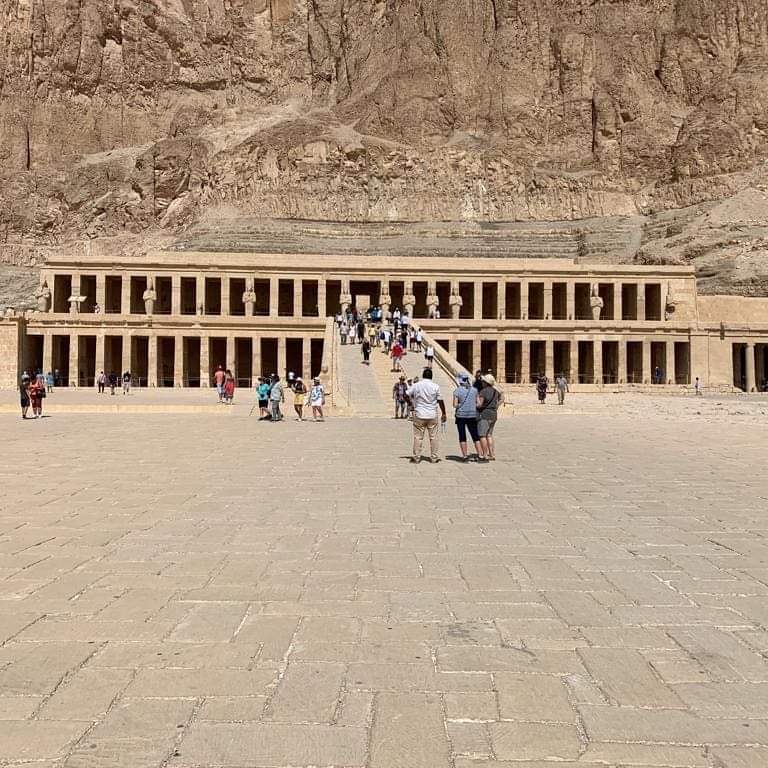
The dramatic terraced sanctuary of Egypt's most powerful female pharaoh, carved directly into the Theban cliffs at Deir el-Bahari.
Overview
The Mortuary Temple of Hatshepsut — known in Arabic as Deir el-Bahari, 'the Northern Monastery' — is one of the most instantly recognisable buildings in the world. Its three golden terraces are carved directly into a cliff-face on Luxor's West Bank, framed by a natural amphitheatre of desert stone.
Built in the 15th century BC for Egypt's most powerful female pharaoh, it is both a shrine and a piece of architectural theatre — a temple that turns the mountain itself into a monument.
History
Hatshepsut ruled Egypt as a full pharaoh for around 22 years in the 18th Dynasty, during one of the most prosperous eras of Egyptian history. Her mortuary temple was designed by her chief architect and closest advisor, Senenmut, in a style then unlike anything else in Egypt.
The temple is a hymn to her achievements — colonnades depict her divine birth, her coronation, and her legendary trading expedition to the fabled land of Punt, from which she returned with myrrh trees, exotic animals and gold.
After her death, her successor Thutmose III systematically erased her image from many walls. Later, Coptic Christians turned part of the temple into a monastery, giving Deir el-Bahari its modern name. Polish and Egyptian restorers have spent decades painstakingly rebuilding it from fallen blocks.
Highlights
- The Three Terraces — Rising in symmetrical ramps against the cliff — a design 3,500 years ahead of its time.
- Chapel of Anubis — Vividly coloured reliefs on the second terrace, still bearing their original paint.
- Chapel of Hathor — Columns topped with the cow-eared face of the goddess, protector of the western desert.
- Punt Colonnade — The famous painted scenes of Hatshepsut's expedition to the land of Punt.
- Sanctuary of Amun — The innermost sanctum, cut into the living rock at the very back of the terrace.
- The Amphitheatre Setting — The way the temple mirrors the shape of the cliffs behind it — best seen from a distance at sunrise.
Visitor Experience
From the ticket gate, you either walk or take a short 'taftaf' shuttle up the causeway toward the temple. As you climb the ramps between the terraces, the views back across the Nile Valley open up dramatically — palm groves in the distance, the cliffs above you.
Inside the colonnades, a Remoza Egyptologist unpacks the story of Hatshepsut's reign — including the family drama between her, her stepson Thutmose III, and Senenmut. Allow around 90 minutes on site.
Best Time to Visit
October to April is the sweet spot — the temple faces east into the morning sun, so arriving right at opening gives you the best light and the coolest air.
In summer, the amphitheatre traps heat spectacularly by mid-morning. Aim to be at the gate by 06:30 or you'll cook by 09:00.
Opening Hours
Hatshepsut Temple is open daily from 06:00 to 17:00 in winter and 06:00 to 18:00 in summer. Ticket sales stop one hour before closing.
Ticket Information
Current Official Entrance Fees
is 440 Egyptian pound per adult and 220 for child only from tickets office by your card only no cash
How to Get There
Deir el-Bahari lies on the West Bank of the Nile, roughly 30 minutes from Luxor's East Bank hotels and Nile cruise moorings. Remoza collects you in a private air-conditioned vehicle with a licensed Egyptologist.
It sits just a few kilometres from the Valley of the Kings and Medinet Habu — the three form the natural spine of any West Bank day.
Practical Tips
- Go first — Visit Hatshepsut immediately after the Valley of the Kings — cooler air, fewer buses, best light.
- Bring a hat — There is almost no shade on the terraces once the sun is up.
- Look up at the ceilings — The Chapels of Anubis and Hathor still have brilliant blue-and-yellow astronomical ceilings.
- Combine with a hot-air balloon — The West Bank balloon flight lands beside the causeway — a magical way to arrive.
- Save the mummy museum — The Mummification Museum on the East Bank pairs beautifully with a Hatshepsut morning.
Frequently Asked Questions
How long does the visit take?
Around 60 to 90 minutes on site, plus travel time. It combines perfectly with the Valley of the Kings and the Colossi of Memnon as a half-day.
Who was Hatshepsut?
Hatshepsut was Egypt's longest-ruling female pharaoh, on the throne for around 22 years in the 18th Dynasty. She oversaw an era of peace, monumental building and long-distance trade.
Is the temple wheelchair accessible?
The ramps between the terraces make it more accessible than most sites, but the surfaces are uneven. Remoza can arrange a slower-paced private visit with wheelchair assistance.
Is it safe to visit today?
Yes. The site is heavily protected and has been for decades — Luxor as a whole is one of the safest tourist regions in Egypt.
Are the colours original?
Yes. The blue, red and yellow you see in the Chapels of Anubis and Hathor are largely original 3,500-year-old pigment, protected by their position deep inside the terraces.
Can I visit at night?
The temple is a daytime-only site — there is no night visit. Luxor Temple on the East Bank is the classic evening pairing.