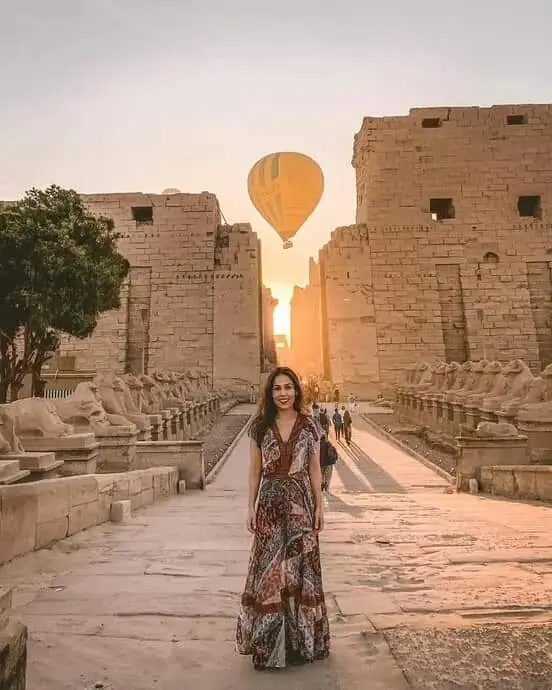
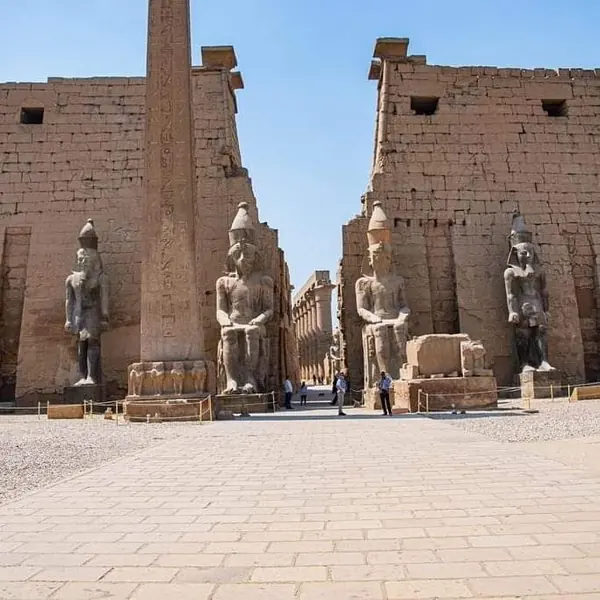
The heart of ancient Thebes — a temple that has been alive with pharaohs, Alexander the Great, Roman legions and a working mosque for 3,400 years.
Overview
Luxor Temple stands in the middle of the modern city of Luxor, along the Corniche of the Nile — a rare ancient monument that is still a living part of the town around it.
Unlike Karnak, which was built over centuries by many pharaohs, Luxor Temple has an almost unified vision: a graceful sanctuary begun by Amenhotep III in the 14th century BC, extended by Ramses II, and later adopted by Alexander the Great, the Romans, early Christians and, finally, by Muslims who built the mosque of Abu Haggag on top of it.
History
Luxor Temple was dedicated primarily to the rejuvenation of kingship. Once a year, during the Opet festival, the sacred statues of Amun, Mut and Khonsu were carried in a great procession from Karnak down the Avenue of Sphinxes to Luxor Temple, where the pharaoh's divine power was ritually renewed.
Ramses II added the massive first pylon, two seated colossi and a matched pair of obelisks — one still stands here, the other has famously stood in Paris' Place de la Concorde since 1836. Later, Roman legionnaires converted a hall into a chapel of the imperial cult, then early Christians frescoed over the pharaonic reliefs.
In the 13th century, the mosque of Sheikh Yusuf Abu Haggag was built into the temple's north-west corner, where it still functions today — one of the great images of continuous sacred use in the world.
Highlights
- The First Pylon — Ramses II's monumental gateway, with reliefs of the Battle of Kadesh and one surviving obelisk.
- Colonnade of Amenhotep III — Fourteen slender papyrus columns 19 metres high, illuminated dramatically at night.
- Court of Amenhotep III — A double row of graceful columns — arguably the most elegant space in all of Egyptian architecture.
- Roman Chapel & Christian Frescoes — Layers of Roman and Coptic history painted directly onto the pharaonic walls.
- Mosque of Abu Haggag — The 13th-century mosque still perched inside the temple — 3,400 years of religion in one frame.
- Avenue of Sphinxes — The newly restored 2.7 km processional road that once linked Luxor Temple to Karnak.
Visitor Experience
Luxor Temple is the perfect end to a Luxor day. Arrive an hour before sunset and you'll see the temple in warm gold light, then watch as it slowly transforms as the temple's dramatic lighting comes on and the columns glow honey-gold against the deep blue sky.
It is a walkable, focused site — a Remoza Egyptologist can bring the story to life in about 90 minutes. In summer, most travelers actively prefer the evening visit; in winter, sunrise here is quietly magical too.
Best Time to Visit
The temple is at its most magical from about 45 minutes before sunset until 21:00, when the illumination is fully lit and the crowds have thinned. In summer, this is the only truly comfortable time to visit.
For photographers, mornings between 07:00 and 09:00 give softer directional light on the colossi of Ramses II.
Opening Hours
Luxor Temple is open daily from 06:00 to 21:00 in winter and 06:00 to 22:00 in summer. Last entry is 30 minutes before closing.
During Ramadan, evening hours are extended to accommodate local visitors after iftar.
Ticket Information
Current Official Entrance Fees
Entrance fees is 500 Egyptian pound per adult / and 250 per child only by card no cash .
How to Get There
Luxor Temple sits directly on the Corniche in the centre of Luxor, walking distance from the Winter Palace, the Sofitel Old Cataract's sister property and most East Bank hotels.
Nile cruise passengers docked in Luxor are typically 5–10 minutes away by private car. Remoza always arranges an air-conditioned vehicle with pickup and drop-off at the temple gate.
Practical Tips
- Visit at night — Even if you visit once in daylight, come back after sunset — the temple is a completely different, more atmospheric place.
- Combine with a Nile-side dinner — The Winter Palace terrace and the Sofitel Karnak have views over the temple's illuminated pylons.
- Walk the Avenue of Sphinxes — A short stretch is easily walkable from the temple entrance — perfect at golden hour.
- Modest dress near the mosque — Shoulders and knees covered when the mosque of Abu Haggag is active.
- Allow 60–90 minutes — The site is compact but layered — don't rush the Roman chapel and colonnade.
Frequently Asked Questions
Is Luxor Temple better by day or by night?
Both are wonderful, but if you can only choose one, visit at night — the temple is beautifully lit, cooler, and considerably quieter.
How is Luxor Temple different from Karnak?
Karnak is the sprawling state sanctuary of Amun. Luxor Temple is smaller, more elegant, and was mainly used for the annual Opet festival that renewed the pharaoh's divine power.
Can I walk between Luxor Temple and Karnak?
Yes — the Avenue of Sphinxes has been fully restored. It's a scenic 2.7 km walk best done in cooler hours or at sunset.
Do I need a guide?
You can visit alone, but a private Egyptologist makes an enormous difference — the layered history of Egyptian, Roman, Christian and Islamic use is easy to miss without commentary.
Is Luxor Temple open during Ramadan?
Yes. Hours may shift slightly and the evening period tends to be busier with local visitors — Remoza will confirm the exact times for your date.
Is photography allowed at night?
Yes. Personal cameras and phones are freely permitted; the night lighting makes it one of the most photogenic places in Egypt.