The largest religious complex ever built — 2,000 years of pharaohs, obelisks and the unforgettable Great Hypostyle Hall.
Overview
Karnak is not a single temple — it is a city of temples. Covering more than two square kilometres on the East Bank of Luxor, it is the largest religious complex ever built by any civilisation, and the beating heart of ancient Thebes for almost 2,000 years.
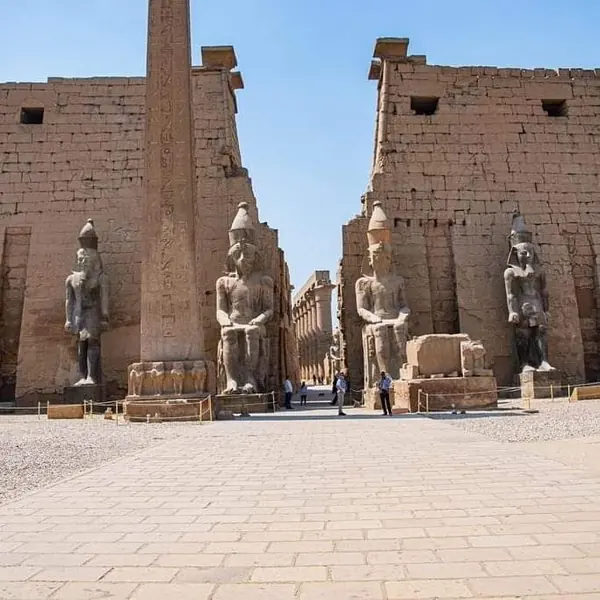
Every pharaoh who mattered — Hatshepsut, Thutmose III, Ramses II, Seti I, the Ptolemies — added a pylon, a chapel, a colonnade or an obelisk to it. The result is a stone forest of columns, sacred lakes, sphinx-lined avenues and towering gateways unlike anywhere else on earth.
History
Construction began during the Middle Kingdom around 2055 BC and continued into the Roman era. Karnak was the principal cult centre of Amun-Ra, king of the gods, alongside his consort Mut and their son Khonsu — the great Theban Triad.
The complex reached its apogee during the 18th and 19th Dynasties, when Egypt controlled an empire from Nubia to the Euphrates. Pharaohs poured tribute into Karnak: gold-plated obelisks, granite colossi, and the famous Great Hypostyle Hall of Seti I and Ramses II — a room the size of a cathedral, forested with 134 stone columns.
Karnak was rediscovered by Napoleon's savants in 1798 and has been under continuous excavation ever since. Restoration by Egyptian, French and American missions continues today, most visibly at the Avenue of Sphinxes reopened in 2021.
Highlights
- Great Hypostyle Hall — 134 sandstone columns up to 22 metres high, still bearing traces of their original blue, gold and red paint.
- Obelisks of Hatshepsut & Thutmose I — Among the tallest surviving obelisks in Egypt, carved from single blocks of Aswan granite.
- Sacred Lake — The 120-metre lake where priests purified themselves — with a granite scarab dedicated to Amenhotep III on its shore.
- Precinct of Mut — The southern sanctuary lined with hundreds of lion-headed Sekhmet statues, many restored in the last decade.
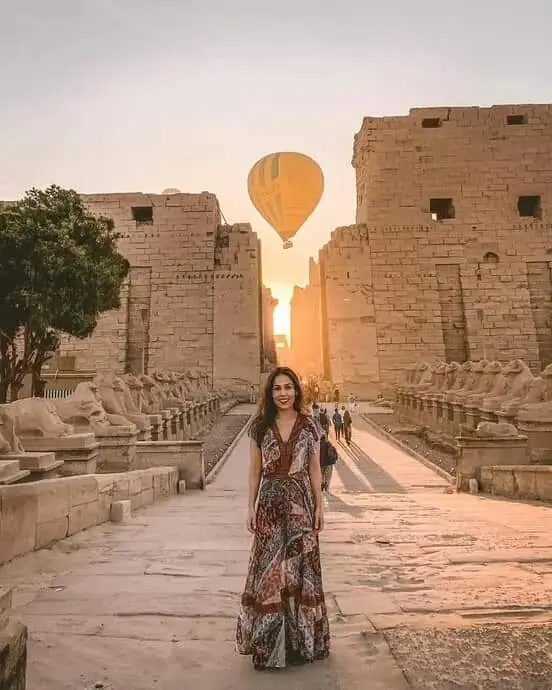
- Avenue of Sphinxes — The 2.7 km ram- and human-headed sphinx-lined processional road, now reconnecting Karnak with Luxor Temple.
- Sound & Light Show — An evening spectacle with dramatic narration and coloured lighting across the temple complex.
Visitor Experience
You enter through the massive First Pylon and immediately face a courtyard the size of a football pitch, ringed by ram-headed sphinxes. From there, the Great Hypostyle Hall opens up — the moment that leaves most travelers speechless. Sunlight filters down between the columns in golden shafts, and you understand why the ancient Egyptians called it 'The Most Select of Places'.
A private Remoza Egyptologist unpacks each layer for you: which pharaoh added which chapel, which cartouches were erased by rivals, and how the temple was oriented to the winter solstice. Allow at least two hours to explore, or three if you include the Open-Air Museum inside the complex.
Best Time to Visit
October to April is the ideal season, with warm days and pleasant mornings. In summer, only visits before 09:00 or after 16:00 are truly comfortable — the hall traps heat.
The best light for photography is between 07:00 and 09:00, when the low sun rakes across the columns of the Hypostyle Hall.
Opening Hours
Karnak is open daily from 06:00 to 16:30 in winter and 06:00 to 16:30 in summer. Last entry is one hour before closing.
The Sound & Light Show runs multiple times each evening in different languages (English, French, Spanish, Italian, Arabic and Japanese, depending on the day). Remoza always books the correct language slot in advance.
Ticket Information
Current Official Entrance Fees is 600 Egyptian pound per adult and 300 Egyptian pound per child pay it by visa or credit card from ticket office no cash only credit
How to Get There
Karnak sits on the East Bank of the Nile, about 3 km north of Luxor city centre — 5–10 minutes by car from most Luxor hotels and Nile cruise ships.
Remoza guests are picked up in a private air-conditioned vehicle and delivered right to the temple's main entrance. Adventurous travelers can also arrive by traditional felucca and horse carriage as a special upgrade.
Practical Tips
- Arrive at opening — The site is enormous — the earlier you arrive, the more you'll enjoy the Hypostyle Hall in silence.
- Combine with Luxor Temple — Do Karnak in the morning and Luxor Temple in the evening for the perfect East Bank day.
- Bring binoculars — The upper reliefs on the pylons and obelisks reward a closer look.
- Save time for the Sacred Lake — The quiet southern side of the complex is often skipped by big groups.
- Sound & Light Show — Choose front-facing seats for the Hypostyle Hall segment — visually the strongest moment.
Frequently Asked Questions
How long do I need at Karnak?
At least two hours for the core complex; three if you add the Open-Air Museum or want to walk the southern axis to the Sacred Lake in detail.
Is Karnak worth visiting if I'm short on time?
Yes — even 90 focused minutes with a private Egyptologist will show you the Hypostyle Hall, the obelisks and the Sacred Lake. Remoza can build a shortened itinerary for cruise-day visits.
What's the difference between Karnak and Luxor Temple?
Karnak was the great state sanctuary of Amun, built over 2,000 years. Luxor Temple is a single-vision, smaller temple 3 km south, once linked to Karnak by the Avenue of Sphinxes.
Is the Sound & Light Show worth it?
For most first-time visitors, yes. It's a theatrical way to see the temple lit at night. Bring a light layer — evenings can be cool in winter.
Can I combine Karnak with the West Bank in one day?
Absolutely. A Remoza full-day Luxor tour typically covers the Valley of the Kings and Hatshepsut in the morning, Karnak in late afternoon and Luxor Temple after dark.
Is Karnak wheelchair accessible?
The main axis is level and largely accessible with assistance, though the ground is uneven in places. Remoza can arrange a dedicated vehicle and a slower, seated-friendly itinerary.