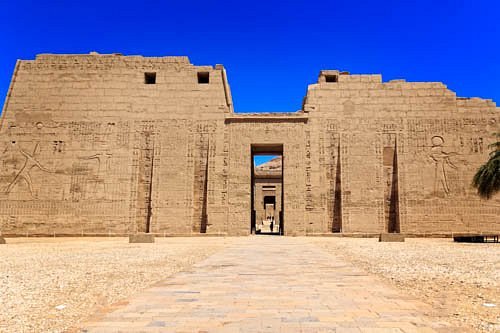
The mortuary temple of Ramses III — a colossal, brilliantly preserved sanctuary that many travelers rank above Karnak.
Overview
Medinet Habu is the great mortuary temple of Ramses III, built in the 12th century BC on the southern edge of Luxor's West Bank. It is the best-preserved of all the royal mortuary temples — many travelers who have seen Karnak and Luxor Temple say Medinet Habu is quietly their favourite.
Its towering pylons still carry deep-cut reliefs of Ramses III's naval battle against the mysterious 'Sea Peoples' — one of the earliest recorded sea battles in human history.
History
Ramses III was the last great warrior pharaoh of the New Kingdom, reigning around 1186–1155 BC. He built Medinet Habu as his 'Mansion of Millions of Years' — both a temple to Amun and a fortress-palace where he lived, judged and ruled.
The complex was fortified with a massive mudbrick enclosure wall and a Syrian-style gatehouse, the Migdol, that made it look more like a citadel than a temple. When the New Kingdom collapsed, Medinet Habu became a walled town — a role it kept, off and on, into the Coptic era.
Because so much of the site was later buried under village houses and rubbish, it survived remarkably well. American and German excavations from the 1920s onward peeled the town away and returned the temple to view — with its paintwork still shockingly vivid in places.
Highlights
- The Migdol Gateway — The fortified Syrian-style entrance where Ramses III received foreign envoys — and, according to a papyrus, was the target of a palace conspiracy.
- First Pylon Battle Reliefs — Enormous carved scenes of the naval battle against the Sea Peoples, deep-cut into the sandstone.
- First Courtyard — Colossal Osirid statues of Ramses III lining a beautifully proportioned courtyard.
- Second Courtyard — Original blue and red paint still clinging to the columns and lintels overhead.
- Small Temple of Amun — An older 18th-Dynasty shrine within the complex, associated with the sacred mound of creation.
- Sacred Lake & Chapels of the God's Wives — Peaceful outer areas that most tour groups miss entirely.
Visitor Experience
Medinet Habu is quieter than the other Luxor headliners — you can often walk through its courtyards with barely another traveler in sight, especially in the late afternoon. The scale is immense, but very human: you get close enough to the reliefs to trace the individual muscles of Ramses III's warriors with your fingertip.
A Remoza Egyptologist walks you through the temple as a story — from the fortified gate to the innermost sanctuary — and finishes at the smaller Amun temple and the God's Wives chapels, where the crowds simply don't go. Allow around 90 minutes.
Best Time to Visit
Late afternoon, roughly 15:30 to 17:00, is the best time — the low sun rakes across the deep reliefs and brings the entire temple to life. In winter, morning visits are also beautiful.
The site is far less popular than Karnak or Hatshepsut, so it stays enjoyable even in the peak season.
Opening Hours
Medinet Habu is open daily from 06:00 to 17:00 in winter and 06:00 to 18:00 in summer. Ticket sales end one hour before closing.
Ticket Information
Current Official Entrance Fees
Entrance fees 220egyption pound per adult / and 110 Egyptian pound per child you can pay it from tickets office by your card only no cash
How to Get There
Medinet Habu sits at the southern end of the West Bank, about 35–45 minutes from most East Bank Luxor hotels and Nile cruise moorings. Remoza always arranges a private air-conditioned vehicle with your Egyptologist.
It combines beautifully into a West Bank full-day tour with the Valley of the Kings and Hatshepsut — with Medinet Habu ideally saved for the golden last hour of the afternoon.
Practical Tips
- Save it for last — The temple is at its most beautiful in late-afternoon light — the ideal finale to a West Bank day.
- Look up — Original blue-and-yellow paint still survives on many ceilings and column tops.
- Explore the outer areas — The God's Wives chapels and Sacred Lake are almost always empty.
- Bring a torch — A small flashlight brings the deeper reliefs into sharp focus.
- Combine with Deir el-Medina — The artisans' village of the tomb-builders is only 10 minutes away — a natural add-on.
Frequently Asked Questions
Is Medinet Habu worth visiting?
Very much so. Many travelers who have seen Karnak and Luxor Temple say Medinet Habu is quietly their favourite Luxor site — the reliefs are deeper, the paint fresher, and the crowds far thinner.
How long does a visit take?
Around 60 to 90 minutes on site, plus travel time. A Remoza private tour usually pairs it with the Valley of the Kings and Hatshepsut as a full West Bank day.
Who was Ramses III?
Ramses III was the last great warrior pharaoh of the New Kingdom. He defended Egypt against the Sea Peoples and Libyans in a series of famous battles depicted on Medinet Habu's walls.
Is Medinet Habu suitable for children?
Yes. The courtyards are open and safe, and the scenes of chariots, battles and captives capture children's imaginations. Children under 6 enter free.
Is photography allowed?
Yes. Personal photography with phones and cameras is included in the ticket; flash and tripods require a permit.
Can I combine it with the Valley of the Kings in one visit?
Absolutely. Remoza's West Bank full-day tour combines Valley of the Kings, Hatshepsut and Medinet Habu with a lunch stop by the Nile.